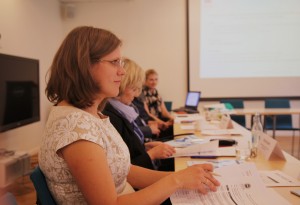
High Level representatives of the Labour Ministries of the CBSS Member States met on the 15th of June 2017 in Berlin, Germany under the auspices of the Icelandic Presidency of the CBSS, at the venue of the City of Hamburg Representation.
The meeting was opened by Mr. Þorsteinn Víglundsson, Minister of Social Affairs and Equality of Iceland and was held as a part of the joint event with the Baltic Sea Labour Forum (BSLF) Annual Round Table. As grounds for discussion, the Policy Recommendations’ paper on issues related to the labour market, based on proposals from BSLF Members, representing both trade unions and employer’s organisations in the Baltic Sea countries, Baltic Sea Parliamentary Conference (BSPC), European Union Strategy for Baltic Sea Region (EUS BSR), Policy Area Education and participants from the Swedish Institute Baltic Leadership Program “Labour mobility”, was delivered to the ministries in advance.
The representatives defined the key areas of cooperation in the field of labour and employment as follows:
Labour mobility: How to reduce brain drain? How can we “stimulate the brain circulation”?
Demographic challenges: How to handle and deal with senior policy and silver economy?
Knowledge supply: How can labour market forecasting, technological foresights and research help to tackle current challenges of the labour market?
Youth employment: How can we maximize opportunities for young individuals in the region? How do the labour markets and regions in Europe need to adapt to the youth’s needs?
Additionally, Bernd Hemingway, Deputy Director of the Council of the Baltic Sea Secretariat focused on migration issues related to the labour market, and highlight possibilities and challenges of the integration of migrants and people with special needs into the labour market.
Read the full adopted Declaration here.
For all presentations of the BSLF Roundtable, please visit the Download section.
See the CBSS Flickr for images from the event.
 A well-functioning skill supply is essential for the competitiveness of the Baltic Sea Region. Skill shortages are already a reality in several member states and the demographic trend is pointing towards an ever-increasing problem. The Baltic Leadership Programme (BLP) Labour Mobility aims at creating a meeting place for relevant actors to discuss opportunities and challenges related to mobile labour market in the Baltic Sea Region. On 30 November 2016, the first module of the programme started in Gdansk, Poland. The programme is a joint effort by the Swedish Institute, the Council of the Baltic Sea States (CBSS), the Norden Association, Policy Area Education and Horizontal Action ’Capacity’ within the European Strategy for the Baltic Sea Region (EUSBSR). BLP-Labour Mobility gives an important input to the further development of the Baltic Sea Labour Forum. BLP-Labour Mobility will be implemented in 2016/17 by starting its first module in Gdansk yesterday, on 30 November, and be finalised with a third module in June 2017 in Berlin, Germany. The programme gathers about 30 participants representing trade unions, employer organisations, state agencies and cross-border services. The result of the programme will be recommendations on how labour mobility can be supported, identifying and removing hindrances but also how the return of needed labour force can be supported, so called “brain circulation”. These recommendations will be ready to be presented at a Round Table in June 2017, involving the Ministers of Labour and Employment of the CBSS Member States. Some of the highlights from the first day were group discussions focusing on building a contextual map of the topic, and an inspiring presentation by Franz Thönnes (MP, former Parliamentary State Secretary, Deputy Chairman of the Committee on Foreign Affairs of the German Bundestag) on “Visions for the Baltic Sea”, accompanied by remarks from Anders Bergström (Strategist, Norden Association). This busy and fruitful day ended with a tour of and a theatre workshop at the European Solidarity Centre in Gdansk.
 The experts addressed with their speeches both the macroeconomic and the organisational level. Dr. Jörg Peschner, Seconded National Expert at the European Commission, DG Employment, Social Affairs and Inclusion, hold a presentation about ageing workforce and its consequences for the European Union member states. He stressed that EU employment growth will turn negative already by 2030 therefore the EU policy shall promote activation policies and measures to accelerate productivity growth (e.g. by tapping unexploited resources such as women, young people, migrants, senior workers etc.). The diverse labour market potentials were also mentioned by Dr. Andrea Hammermann from Cologne Institute for Economic Research: “Labour market of the future is not only ageing and shrinking, it is also getting more diverse. We have to think about a labour market which will be a little bit more female, there will be more migrant workers, and therefore, there will be more heterogeneity in demands which both companies and employees have to think about in order to find flexible solutions”. Prof. Dr. Mirko Sporket, University of Applied Science in Münster (Germany), addressed the organizational level and introduced the concept of “demographic literacy” which shall help companies to gather and evaluate the crucial “demographic information” and to develop actions in order to overcome challenges such as labour shortages.
  The conference participants shared good practices of employers and trade unions and identified needs for further transnational cooperation. Nine exhibition stands offered information about practical age management experiences. The visitors had the chance to talk to company representatives and partners of the Best Agers Lighthouses project. The scientific and practical findings of the project fed into recommendations for Social Partners and Policy-Makers as well as for Employers. Read the full conference report here and download the presentations and recommendations: